



Europe continues to attract professionals from across the world with its balanced lifestyle, strong worker protections, and competitive pay structures. However, salaries in Europe vary greatly depending on the profession, country, and experience level. In 2025, while the average salary across the European Union hovers around €3,100 per month, professionals in certain industries earn significantly more — especially in technology, healthcare, and finance.
In this article, we’ll look at the average salaries in Europe by profession, highlight the highest-paying countries, and explore what factors truly influence your earning potential.
Salary Trends Across Europe in 2025
The European job market has evolved significantly in the past few years. Remote work, automation, and AI-driven industries have shifted the salary landscape.
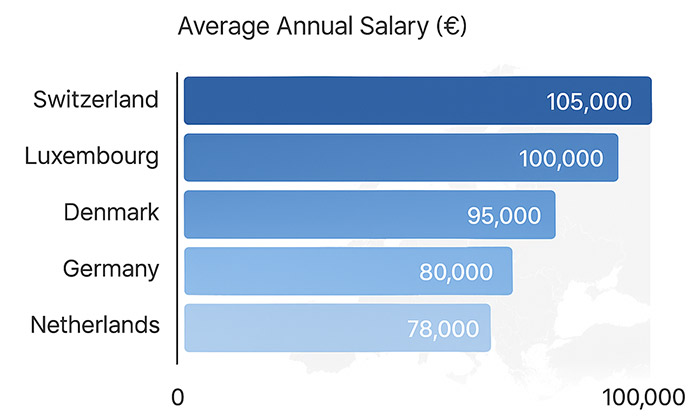
Countries like Switzerland, Luxembourg, Denmark, and Germany remain at the top in terms of average pay. For example, a full-time professional in Luxembourg can expect a gross monthly income above €6,000, while in Denmark, the average sits around €5,600. On the other hand, many Eastern European nations still offer lower average pay, ranging between €1,200 and €2,000 per month — though living costs are proportionally lower.
This wide disparity reflects not only differences in cost of living but also the types of industries that dominate each economy. Western Europe tends to have more technology, finance, and engineering roles, while Eastern Europe sees growth in manufacturing, service, and IT outsourcing sectors.
Profession-Wise Salary Breakdown
Here’s a profession-wise breakdown of approximate annual gross salaries in Europe (estimates for 2025), using available data. Note: “Europe” is broadly interpreted and some variations apply by country/region.
Profession | Approximate Annual Salary (EUR) | Notes / Regional Variation |
Software Engineer / Developer | ~ €45,000–€90,000 (mid-level) | In Germany for example, IT/Engineering mid-senior roles range ~€60k-€90k. |
Data Scientist | ~ €52,000–€80,000+ for many European markets | Germany ~€75k median, senior could reach €90k+ in strong markets. |
UX/UI Designer | ~ €45,000–€75,000 (mid-senior) | Though exact pan-Europe figures are patchy, given tech/design demand this range is realistic. |
Marketing Manager | ~ €50,000–€80,000 | In mature Western European markets. |
Finance / Accounting (Analyst to Manager) | ~ €48,000–€85,000 | In Germany for example finance roles range ~€48k-€130k depending on seniority. |
Healthcare Professional (Doctor / Specialist) | ~ €100,000+ for high-specialty doctors in e.g., Germany. | Specialists in Germany earned €100k+; medics and surgeons top the range. |
Teacher / Education Professional | ~ €38,000–€80,000 depending on country and seniority | In Germany education & research roles cited ~€52k median. |
Hospitality / Tourism / Service Industry | ~ €28,000–€60,000 depending on role & seniority | Less specialization, more regionally variable. |
Top-Paying Countries in Europe
When it comes to overall earning potential, the following countries consistently top the list:
- Switzerland – Known for banking, pharma, and engineering sectors, average annual pay often exceeds €100,000.
- Luxembourg – Europe’s financial hub with top salaries in finance and IT.
- Denmark – High living standards with strong pay in healthcare and technology.
- Germany – Europe’s largest economy with balanced opportunities across industries.
- Netherlands – Attractive for tech, design, and international professionals due to its startup ecosystem.
What Influences Your Salary in Europe
Several key factors determine how much you can earn in Europe:
- Cost of living: Western Europe pays more but also costs more to live in.
- Industry demand: Tech, healthcare, and renewable energy roles offer the highest growth.
- Experience and specialization: Senior professionals earn double or triple the entry-level pay.
- Country and city: Berlin and Munich pay differently; so do Paris and Lyon.
- Remote work: Cross-border hiring is on the rise — many professionals now live in affordable countries while working for high-paying Western European firms.
- Language and mobility: Speaking local languages like German, French, or Dutch can significantly boost employability and pay.
Finding the Right Role in Europe with NextMoveAbroad
Navigating the European job market can be challenging, but NextMoveAbroad makes it simple. They help you identify the right country and role that matches your skills and experience, whether you’re a UI/UX designer, product lead, or tech professional.
NextMoveAbroad also assists in optimizing your CV and portfolio to meet European standards, ensuring your experience and achievements stand out. They connect you with employers who value your expertise and provide guidance on competitive salaries, benefits, and negotiations.
Beyond landing the role, NextMoveAbroad supports you with relocation, visa processes, and onboarding, helping you focus on starting your new job smoothly. Their goal is to make your move to Europe not just successful, but strategically aligned with your career growth.
